The post The Identity We Postponed: Who Are You When the Mission Ends? first appeared on Military Spouse.
—
Before military life, I was a little wild.
Not reckless—just alive in a way that didn’t ask for permission.
I was the kid smuggling art supplies into school in the pockets of my overalls. I wrote everything down—ideas, stories, thoughts that didn’t have a place yet but felt too important to lose. I spent years flying down streets on skates, adrenaline rushing, hair soaked in sweat, chasing whatever felt like movement and freedom.
In college, I ate peanut butter for a week just so I could afford tickets to Austin City Limits.
I wanted to experience life, trying new things, exploring, and creating. I wanted to know what was possible and chase it down.
And then, slowly—almost imperceptibly at first—that version of me began to disappear.
It didn’t happen overnight. There was no single moment where I decided to set myself aside. It was a series of small decisions over a number of years. I put my art supplies away. I gave my time to what needed to be done. I adjusted. I adapted. I was “resilient.”
And over time, I noticed something had shifted.
My time wasn’t really mine anymore. My energy, my attention, my capacity—it all belonged somewhere else. To the household. To the kids. To the mission. To the systems that kept everything running.
I became efficient. Capable. Reliable.
And without realizing it, I became administrative. I managed everything. I was the primary parent and person who kept the machine moving. Somewhere in that process, I stopped being personal. I stopped being someone who created, explored, or chose things simply because I wanted to.
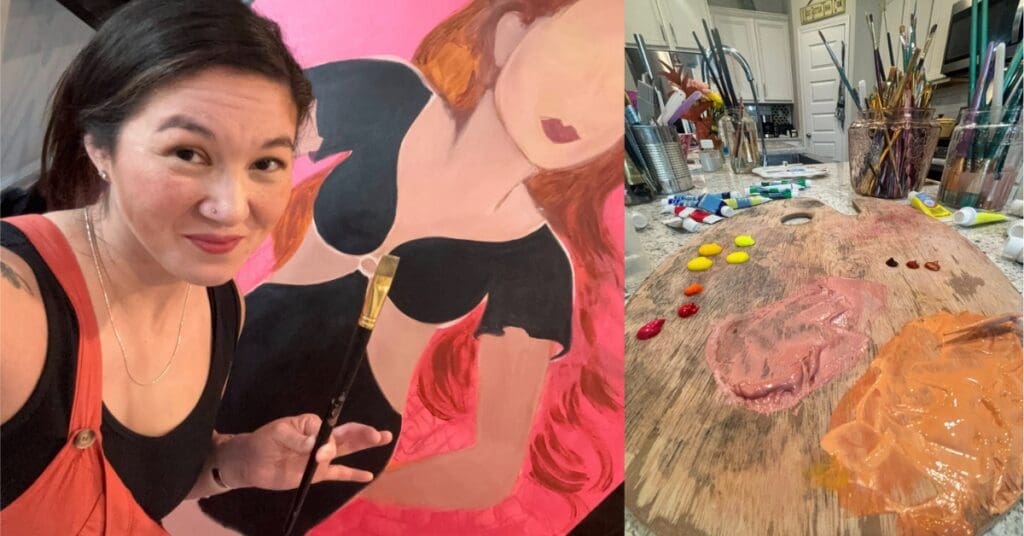
Years passed, more than I care to admit. At one point, I realized it had been nearly fifteen years since I had picked up a paintbrush.
Fifteen years.
That realization doesn’t hit all at once. It creeps in through moments you don’t expect.
For me, it was a simple question.
“What do you do for fun?”
I didn’t have an answer.
Not a vague one. Not a half-answer. Nothing.
I couldn’t remember the last time I had gone to see a movie just because I wanted to. I hadn’t tried a new restaurant out of curiosity. I wasn’t pursuing anything that felt like joy or exploration.
Every day felt like eight hours of survival mode, repeated on a loop. That’s when the question underneath the question started to surface. Who am I… outside of what I do for everyone else?
It’s a disorienting place to stand.
Because once you start asking that question, you also realize something else:
You don’t actually know the answer.
That realization brings its own kind of grief. There is grief for the years that passed and for the opportunities that didn’t happen. Ultimately, there is grief for the versions of yourself that never had the space to fully develop.
Military life has a way of teaching us to wait.
Wait for the next duty station.
Wait for the deployment to end.
Wait for the kids to get older.
Wait for things to settle down.
And somewhere along the way, we start to believe the lie:
There will be time later.
Later, I’ll figure out what I want.
Later, I’ll get back to the things I love.
Later, I’ll rediscover who I am.
But later is not what we think it is.
Later doesn’t come with extra time, extra energy, or fewer responsibilities. Later comes with more complexity, more layers to sort through, and more distance between who you were and who you are now.
“Later” also comes with harder questions to answer.
Identity postponement happens quietly in military families because we are constantly maintaining something.
The household.
The schedule.
The emotional well-being of our children.
The stability of a life that is, by design, unstable.
In the process, we forget to ask ourselves how we actually feel.We know we are somewhat functional, and somehow holding things together. But, do we actually know how we feel?
Reclaiming identity doesn’t happen in one big moment of clarity. It happens slowly and begins with curiosity.
What do I actually enjoy?
What am I drawn to?
What have I missed?
It requires honesty. Don’t romanticize the past, but acknowledge it.
Stop pretending everything is fine, but admit what feels absent.
It requires experimentation.
Trying new things.
Returning to old ones.
Replacing habits and beliefs that no longer serve you.
For me, it started with picking up a paintbrush again in 2024 and making a decision. I will not put this down again. Not because painting solves everything, but because it represents something I am no longer willing to sacrifice.
The goal isn’t to become who you were twenty years ago.
That version of you existed in a different season, with different circumstances.
The goal is to know who you are now, to understand what drives you today. Recognize what you need, what you value, and what you want your life to reflect moving forward.
Because the mission—whatever it looked like in your life—doesn’t get to define you forever.
At some point, you get to decide what comes next.
And that decision starts with a simple but difficult step:
Know who you are now and have the courage to build a life that reflects it.
Debrief complete. Adjust accordingly.
Megan
The post The Identity We Postponed: Who Are You When the Mission Ends? first appeared on Military Spouse.